Feminist organization
The FIQ is a feminist organization with a 90% female membership. In partnership with other feminist groups, it actively promotes and defends women’s rights and publicly denounces inequalities and harm. Workplace violence, family-work-study balance, the role of caregivers, pay equity, poverty and the role of women in decision-making are all core concerns at the FIQ.
Status of Women Committee
The Status of Women Committee ensures a strong feminist approach is used in the various decision-making bodies, helps organize the Women’s Network, and helps create local status of women committees in FIQ affiliated unions.
Women’s Network
The Women’s Network is a place for feminist thought and action to address issues that affect healthcare professionals as women.
Victim of violence?
The FIQ has a registry of organizations throughout Quebec that help women who have been victims of violence.

Predominantly female jobs held by healthcare professionals will be evaluated based on the changes since 2015 and compared to equivalent predominantly male jobs in the public and parapublic sectors in Quebec. Salaries can then be adjusted accordingly.
A few events that occurred between 2015 and 2020 that could impact the value of a job:
- The creation of new jobs
- New collective agreements
- Amendments to labour laws
- Changes to the requirements of professional orders
- Changes to training requirements
End of the 2020 pay equity audit ad hoc committee
With the submission of complaints, the 2020 ad hoc committee concluded its mandate.
2025 pay equity audit committee with the Treasury Board and Inter-union
For the 2025 pay equity audit, the Treasury Board proposed carrying out the work in a committee with the unions representing the employees in the parapublic plan. The Inter-union unions accepted this proposal. This will therefore be the first time since the initial pay equity audit (2001 to 2006) that the employer and union parties will work together.
The inter-union is comprised of the FIQ, CSN, FTQ, APTS, CSQ, SPGQ and the FAE.
New ad hoc committee
The submission of complaints marked the end of the 2020 ad hoc committee’s mandate. A new committee has been set up for the 2025 pay equity audit exercise. It comprises the following people:
Political responsibility
Julie Daignault, Vice-President
Members:
• Martine Gauthier, Licensed Practical Nurse, Syndicat des professionnelles en soins du Nord-de-l’Île-de-Montréal
• Marika Turcotte, Nurse Clinician, Syndicat des professionnelles en soins des Cantons-de-l’Est
• Michèle Vallée, Northern Clinic Nurses, Syndicat des professionnelles en soins de l’Eeyou Istchee
• Marie-Christine Tremblay, Respiratory Therapist, Syndicat des professionnelles en soins de la Capitale-Nationale
• Judith Pellerin, Specialized Nurse Practitioner, Syndicat des professionnelles en soins du Saguenay – Lac-Saint-Jean
• Mathieu Chaput, Clinical Perfusionist, Syndicat interprofessionnel de la santé de l’IUCPQ
2020 pay equity audit posting
On December 20, 2023, the Treasury Board posted its 2020 pay equity audit work. Although it met the minimum legal requirements, the information provided remains very general and did not meet the FIQ’s expectations.
In fact, the Treasury Board concluded that between December 21, 2015 and December 20, 2020, no events occurred that resulted in a disparity requiring salary adjustments between job categories with a predominantly female workforce and those with a predominantly male workforce. In the FIQ’s view, the limited information made available by the Treasury Board did not allow for such a conclusion to be reached.
In May 2024, the FIQ submitted union complaints, on behalf of its affiliated unions and individual complaints. The FIQ thus ensured that its members’ rights were protected and defended.
Understanding equity
Causes, laws and process
The FIQ’s role
Collective battles and work underway
Fighting against violence
While violence in the health sector is widely known and documented, it is still largely under reported. Without denying the cumulative impact of other types of violence, in the health sector it stands out because it is predominantly female, which means women are the main targets. Organizational factors can also exacerbate types of violence, which is why it is critical we take action on all fronts:
- Female stereotypes
- Culture of silence
- Deficient organization of work
Implementing a truly non-violent work culture is a priority for the FIQ. Violence in the workplace is a complex matter, in particular since there is still a strong culture of silence around it. We hope to reverse this trend with our policy for fighting against violence.
Fair representation of women in positions of power and decision-making
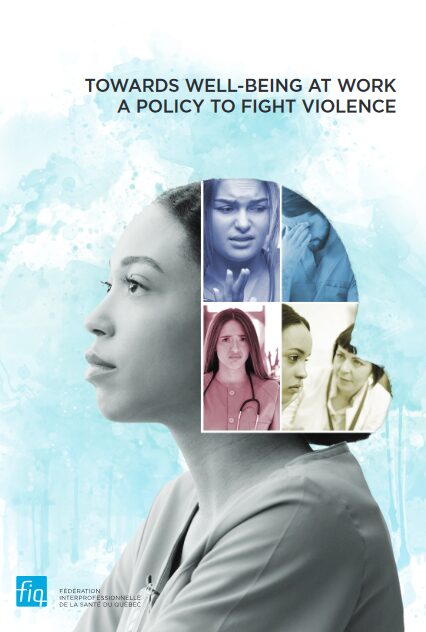
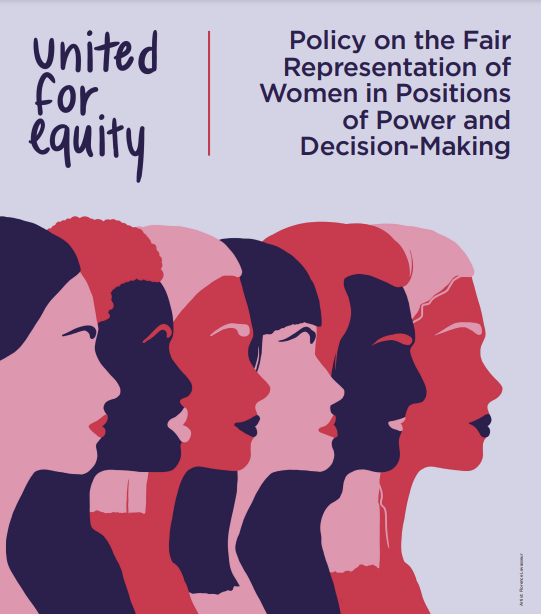
The Federal Council’s delegation approved a policy for the FIQ that ensures fair representation of women in all places of power. The proposal reflected a need revealed by the Status of Women Sector’s analysis, which show that there was a decrease in involvement among women at several levels of power. At the 1988 convention, women made up 88% of the delegation, however, this percentage dropped to 75% at the 2014 convention, and then to 72% at the 2017 convention. This could lead to the under-representation of women in an organization with a 90% female workforce.
The FIQ will continue to:
- promote women’s rights;
- take a public stand on behalf of those who are more vulnerable and cannot speak up;
- be a leading organization on the status of women in Quebec society and, due to its ties of solidarity, strive to achieve gender equality throughout the world.
We need to ensure that healthcare professionals participate at every level of decision-making power and influence.

8 mars
2023

2022

2021
2020
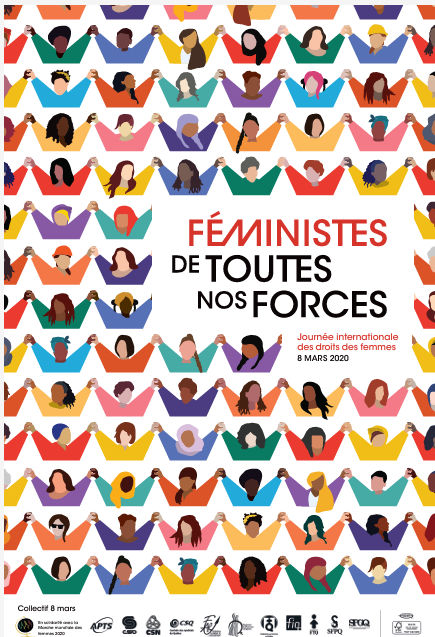
2019
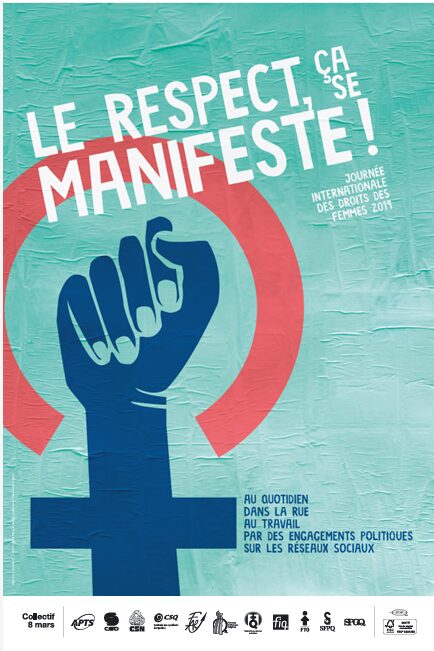
2018
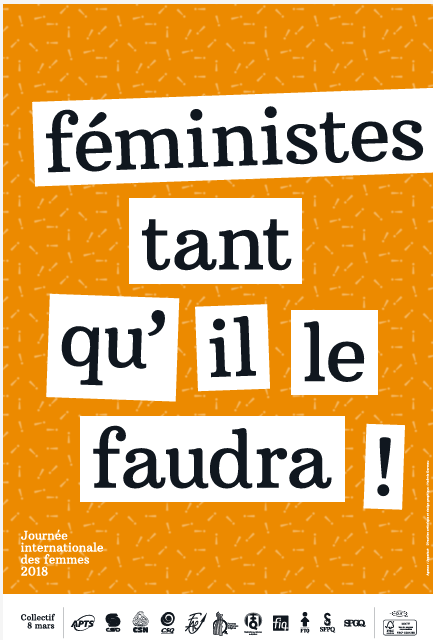
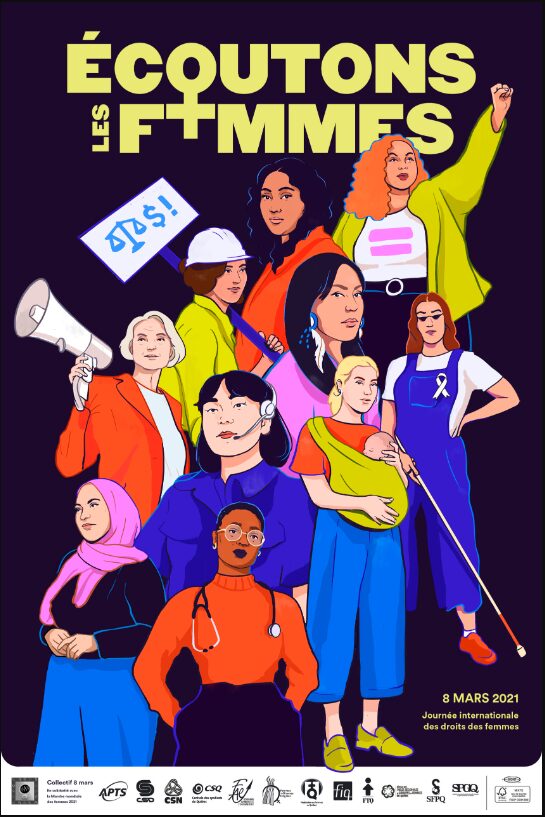
Created in 1977, the Intersyndicale des femmes represents nearly 300,000 unionized workers in the public and parapublic sectors, as well as the private sector. It is composed of status of women representatives from seven labour organizations: the Alliance du personnel professionnel et technique de la santé et des services sociaux (APTS), the Centrale des syndicats démocratiques (CSD), the Centrale des syndicats du Québec (CSQ), the Fédération autonome de l’enseignement (FAE), the Fédération interprofessionnelle de la santé du Québec – FIQ, the Syndicat de la fonction publique et parapublique du Québec (SFPQ) and the Syndicat de professionnelles et professionnels du gouvernement du Québec (SPGQ).
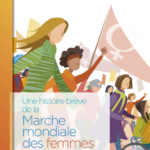
World March of Women
Did you know that Quebec women started the march of women, which then became international?