Nursing in Europe and Canada | concerted efforts to recruit and retain personnel
Nursing is the backbone of healthcare systems around the world. However, the vast majority of countries have been experiencing a particularly acute crisis since the COVID-19 pandemic: there is a shortage of nursing staff in all health networks.
The World Health Organization (WHO) projects that the global shortage of health workers will be 18 million by 2030, including 4 million nursing personnel. Faced with these global challenges, the response is unanimous: we must find ways to ensure a secure nursing workforce, meaning we must be able to count on sufficient staff to ensure the health of patients, but also that of caregivers.
To accomplish this, many organizations, particularly in Europe and Canada, are joining forces and relying on scientific data to guide them in implementing new models, such as safe staffing ratios.
European countries participating in the Nursing Action project
Launched in January 2025 by the European branch of WHO and the European Commission, the Nursing Action project aims to implement, in countries of the European Union, evidence-based solutions to increase the attraction and retention of nursing personnel.
A recent study published as part of this project insists there is a direct link between safe staffing and patient safety, the well-being of personnel and the performance of healthcare networks and compares the countries’ different approaches to this personnel crisis. The study also identifies working conditions, workforce planning, training, professional autonomy and leadership, as fundamental essentials to safe staffing, as well as the alignment between nursing skills and patient needs.
This data equips the countries and organizations to select governance models, types of regulations and funding that best meet the needs of their population.
Canada: establishment of the National Council for Nurse-Patient Ratios Implementation
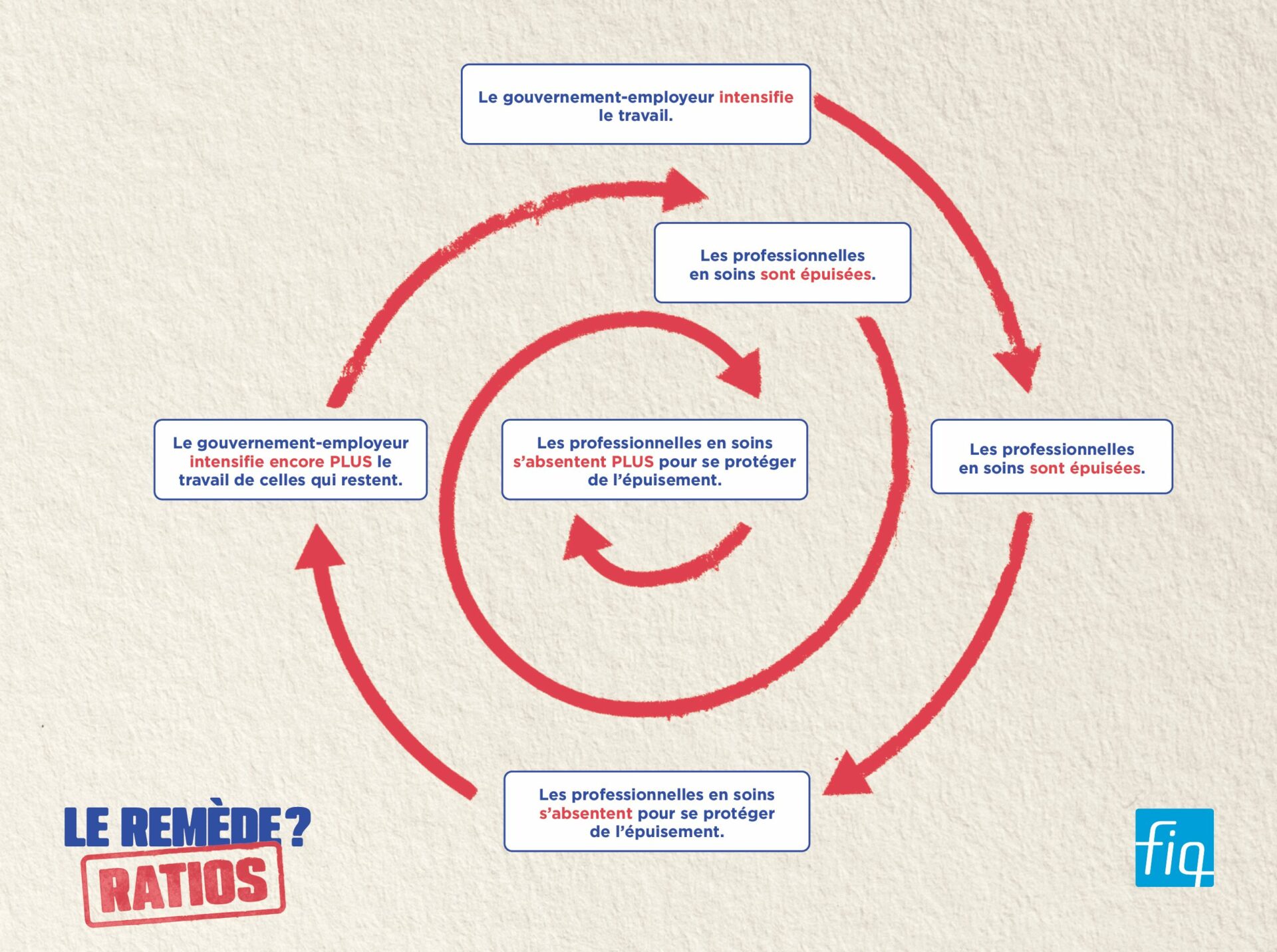
Charting a course out of the vicious circle of nursing shortages in the public health system is also the goal of the newly formed National Council for Nurse-Patient Ratios Implementation, co-chaired by the president of the Canadian Federation of Nurses Unions, Linda Silas and Kerry Morrison, Provincial Chief Nursing Officer of British Columbia. The first meeting was held in mid-February.
As in Europe, scientific data guides the thinking, as numerous studies spanning several decades conclude that having a high number of nurses and healthcare professionals improves staff and patient safety. The Council therefore aims to coordinate knowledge, resources and advocacy efforts across Canada to implement a framework for the implementation of nurse-to-patient ratios, a measure that saves lives.
All provinces, whether they have turned to ratios or not, are represented on the Council by unions and employers. For Québec, where the battle to obtain ratios still continues, the FIQ is represented by its vice-president for Organization of Work and Professional Practice, Jérôme Rousseau, while the Ministry of Health and Social Services is represented by its Directrice générale des secteurs interdisciplinaires (DGSI) (Managing Director of Interdisciplinary Sectors), Brigitte Martel.
In April 2023, British Columbia became the first province to commit to establishing minimum nurse-to-patient ratios. Nova Scotia followed suit only a few months later. Over the past few months, the Manitoba government, employers and the Manitoba Nurses Union (MNU) agreed to work on a safe staffing model, including recommendations covering its implementation.
These advances lead Linda Silas to assert that “Safe nurse-to-patient ratios are critical to solving the nursing shortage and addressing the moral distress plaguing nurses who are working chronically over-capacity”. It’s high time to make this change and save lives across the country.
Sign up for our newsletter