Potentially traumatic events
Unlike the general public, for whom such events are very rare, healthcare professionals are regularly exposed to potentially traumatic events (PTEs) due to the nature of their work. Every day, they are confronted with human suffering, distress, aggression and impatience on the part of patients and their families. Healthcare professionals, in fact, rank 3rd among the professions most at risk of being exposed to PTEs (Source: https://crosh.ca/wp-content/uploads/2023/11/PTSD-Information-Booklet-Single-Page-Spread.pdf . Some departments are proving to be more critical, including emergencies, psychiatry and CHSLDs.
What is a potentially traumatic event?
This refers to exposure to an incident involving either the death or risk of death of a person, a serious injury, a death threat or exposure to sexual violence.
Exposure to this type of incident for a healthcare professional can occur in various ways:
- As a victim who has been directly exposed
- As a direct witness to an incident involving another person
- As an indirect witness, on learning that a loved one or colleague has been involved in an incident
- Being repeatedly exposed to horrific and distressing elements in the course of her work
Exposure to a PTE can lead to an injury affecting psychological health and lead to post-traumatic stress disorder (PTSD).
Possible reactions
During and immediately after exposure to a PTE, healthcare professionals may experience anxiety and dissociation and, subsequently, exhibit other reactions. These reactions are normal when faced with an abnormal situation, and can have a wide range of effects on health and well-being:
- Social: difficulty maintaining relationships, unhealthy attachment, isolation
- Physical: flashbacks, hypervigilant, problems sleeping, nightmares about the incident, stomach problems, or changes in appetite
- Behavioural: using certain substances to avoid or numb emotions, stopping activities that were previously enjoyed, neglecting personal care routines, self-destructive behaviour
- Emotional: anxiety, insecurity, guilt, sadness, shame, fear, negative thoughts, feeling exhausted, angry, or numb
- Psychological: suicidal ideas, suicide attempts, development of nervous ticks, obsessive-compulsive disorder (OCD), mental health disorders including problems related to substance abuse
- Cognitive: memory loss, difficulty focusing
- Etc.
Individual differences, including, among other things, previous traumatic experiences, extroversion, genetic and physiological characteristics can influence the response to stress and exposure to PTEs.
For more information: Ce que vous pouvez éprouver suite à un événement traumatique
Acute stress disorder vs post-traumatic stress disorder
These two conditions exhibit essentially the same symptoms, but what distinguishes them is the duration of the symptoms. Acute stress has a maximum duration of 30 days. Beyond this period, it develops into post-traumatic stress disorder. The first 30 days are therefore crucial in preventing the development of PTSD: a disorder that can persist long after the incident and cause lasting psychological effects that impact both personal and professional life.
What to do after an exposure to a PTE?
Because PTEs may result in short- or long-term work stoppages, it is strongly recommended that the healthcare professionals concerned complete the employer’s work accident form.
Furthermore, it is recommended to consult a doctor to open a file with the CNESST.
PTSD has recently been added to Schedule A of the Regulation respecting occupational diseases. Having an open medical file from day one makes it easier to assert one’s rights.
For more information: Conseils et stratégies pour gérer les réactions post-traumatiques
Psychological first aid
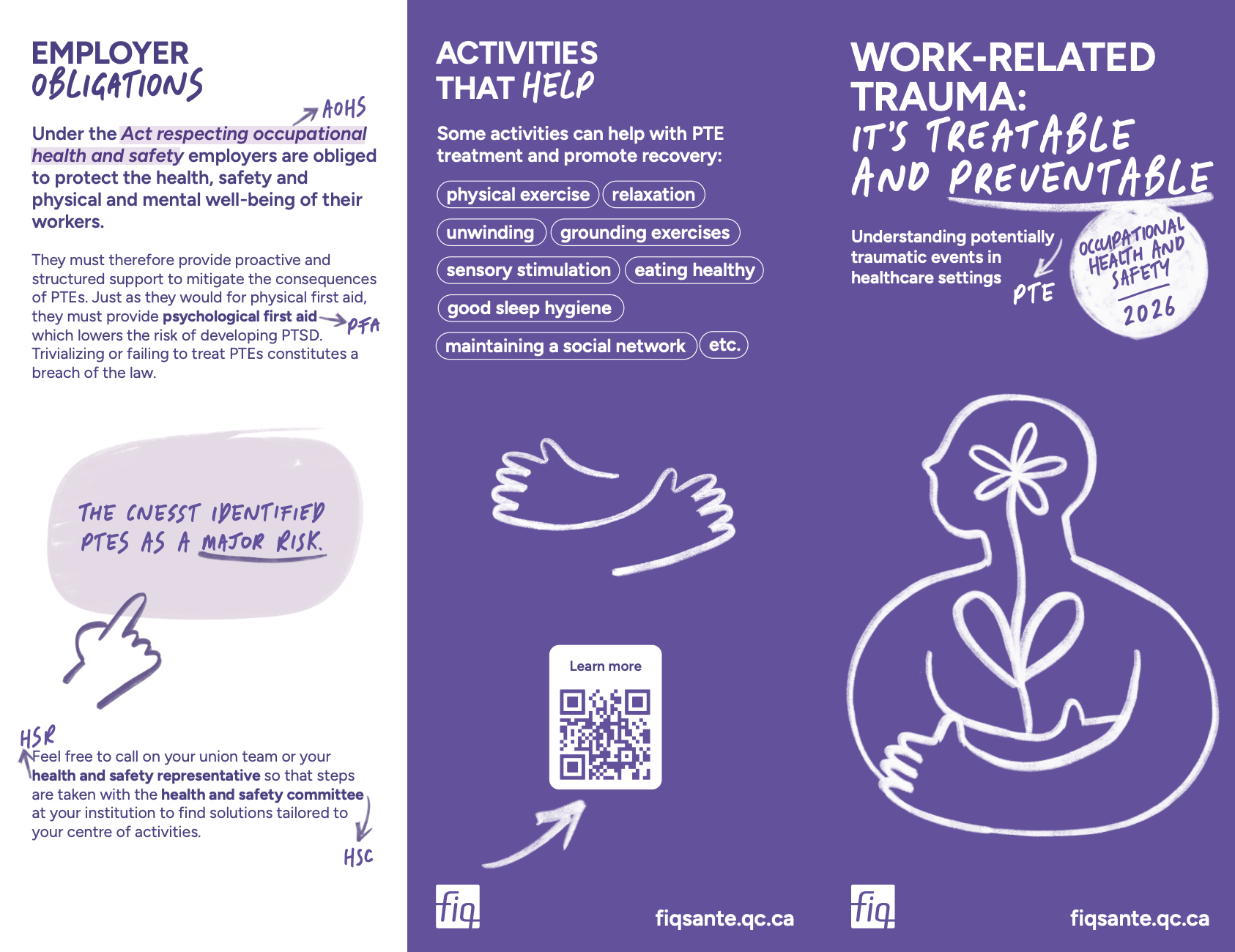
Under section 51 of an Act respecting occupational health and safety (OHS Act), “Every employer must take the necessary measures to protect the health and ensure the safety and physical and mental well-being of his worker.” This obligation includes exposures to PTEs, which are classified as psychosocial risks (PSRs) and identified by the CNESST as a predominant risk.
To mitigate the effects of a PTE, the employer must provide psychological first aid (PFA) in the same way as they provide physical first aid. PFA involves creating a sense of security and helping people exposed to a PTE regain their composure. If necessary, additional resources are available. PFA reduces the risk of developing PTSD and supports protective factors. Of these, social support is the most important. The month following a PTE is crucial for identifying signs of distress, responding appropriately and preventing the persistence of post-traumatic reactions.
For more information:
True or false?
False. Although you have been trained to work in stressful situations involving certain types of trauma, you are only human. If, for example, your life is at stake, it is only natural that this should exceed your tolerance threshold.
False. It is possible that these reactions may subside after a while. However, to prevent PTSD, it is best to seek help as soon as possible so that you can recover quickly and without any long-term effects.
False. The major difference between the two is the source of the stressor. In the first case, it is of a traumatic and work-related nature, while in the second case, it is of a personal nature (break-up, loss of employment, etc.).
Solutions within your reach
Pay close attention to feedback from your family and friends, your colleagues and manager. They may notice that you have changed and let you know.
Don’t hesitate to call on your union team or health and safety representative so that steps can be taken with your institution’s health and safety committee, to find solutions adapted to your centre of activities.
Two fact sheets have been drawn up on this subject to facilitate the implementation of PFA in a centre of activities:
- Une approche adaptée aux travailleurs pour le soutien post-traumatique
- Guide d’implantation d’un programme de premiers soins psychologiques
Take an interest in activities that support recovery:
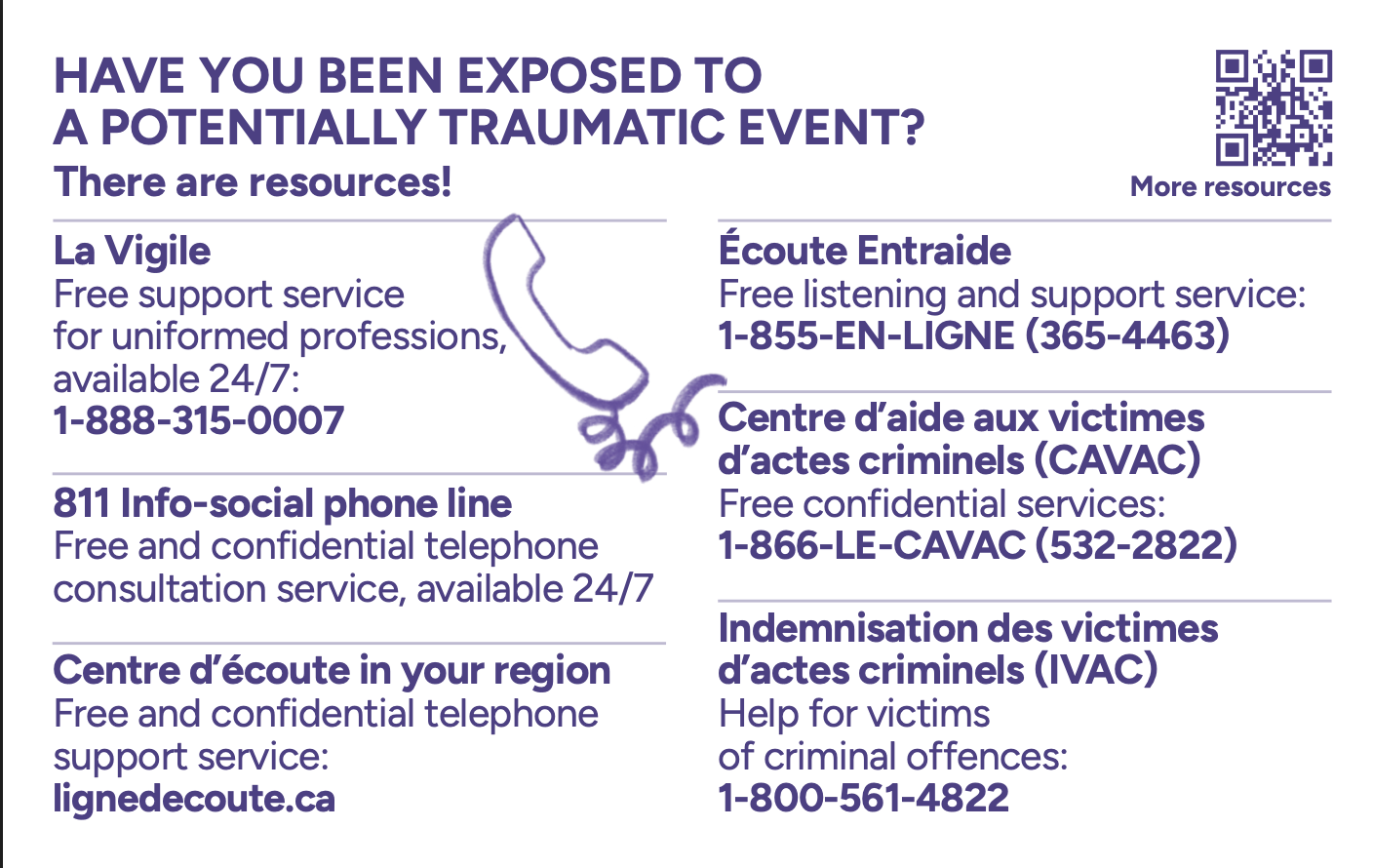
Resources
- Consult a doctor: medical assistance, complete the CNEEST form
- Employee Assistance Program (EAP): a professional support service offered to staff within the health and social services network
- Consult a psychologist, a psychotherapist, or a social worker
- La Vigile : a free 24/7 support service for uniformed professions
- Ligne Info-Social 811: a free and confidential 24/7 telephone counselling service with a psychosocial support worker
- Centre d’écoute de votre région: a free and confidential telephone helpline
- Écoute Entraide : free counselling and support service
- Tel-Aide: frontline public health service
- Centre d’aide aux victimes d’actes criminels (CAVAC): free and confidential services
- Indemnisation des victimes d’actes criminels (IVAC): support for victims of criminal offences
- Association québécoise de prévention du suicide: a professional and confidential support service available 24/7, by telephone, text message and online chat
- Ligne d’aide en cas de crise de suicide 9-8-8: 24/7 listening service
- SOS violence conjugale: services for victims, the general public and all those affected by domestic violence
- Drogue, aide et référence: listening, support, information and referral
- Association paritaire pour la santé et la sécurité du travail du secteur affaires sociales
- Relief.ca: services to help people cope with anxiety and depression
- 911: emergency services