Taking a stand to improve care
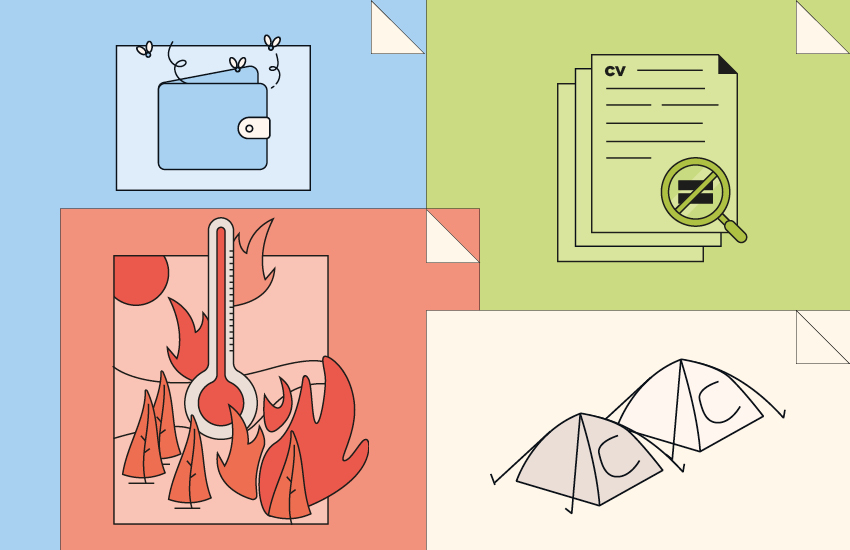
What affects the population’s health? Can we stand idly by in the face of inequality? Should we wait for the next political, economic, environmental or public health crisis to demand change?
The answers to these questions are very important, especially during an election campaign where there are so many debates on the issues. Health is political and healthcare professionals are on the front line to see the impacts of public policies on care. Inequality has repercussions on our daily lives, so either we put up with the consequences, or we take a stand for better care!
Environment
The health of the planet is inseparable from the health of the population and we can already feel the impacts of climate change:
- Climate change : 841 deaths heat-related in summer of 2024 in Quebec[1] and 82,100 premature deaths in the world caused by Canada’s forest fires in 2023[2]
- Deterioration in water and air quality : For nearly 100 years in Rouyn-Noranda, the Horne Smelter has been discharging carcinogenic pollutants, and cancer rates are higher there[3]
Solutions: making coherent policy choices, investing in prevention and adapting the healthcare system to cope with extreme weather events.
[1] Institut national de santé publique du Québec. Vagues de chaleur extrême et chaleur estivale au Québec : impacts sur la santé de 2010 à 2024
[2] The Canadian Press. Study estimates 2023 Canadian wildfire smoke caused 82,000 premature deaths globally
[3] Institut national de santé publique du Québec. Évaluation du risque cancérigène attribuable aux concentrations d’arsenic et de cadmium dans l’air de la ville de Rouyn-Noranda
Housing
When housing is too expensive, unsuitable or substandard, it has a profound and lasting impact on people’s physical, mental and social health:
- Rise in homelessness : a 50% increase in the number of people visibly experiencing homelessness over three years in several regions of Quebec (Abitibi-Témiscamingue, Laurentians, Côte-Nord, Laval and Saguenay–Lac-Saint-Jean)[1]
- Mold and vermin that cause respiratory problems (SOS – we need respiratory therapists!)
- Less money to spend on food, heating, and living : more than 30% of people who live in unaffordable or inadequate housing can no longer afford the cost of food[2]
Solutions: strengthen local health services and access to mental health resources; take action at the source to regulate and hold uncooperative landlords to account; build social housing and offer support to at-risk people.
[1] Ministère de la Santé et des Services sociaux. L’itinérance visible au Québec et son évolution – Résultats préliminaires de l’exercice du dénombrement 2025
[2] Observatoire québécois des inégalités. Crise du logement au Québec : quels effets sur l’insécurité alimentaire?
Poverty
873,000 people had a low income in Quebec in 2023[1]
Poverty affects a person’s health and poor health keeps them poor. With the rise in cost of living, people are increasingly feeling the impacts of economic instability:
- Difficulties in accessing health care, education and educational resources : Approximately 22% of students from disadvantaged backgrounds completed their schooling without a qualification, and a low level of education is associated with a higher prevalence of chronic diseases[2]
- Limited access to nutritious food increases the risk of comorbidity : 1,723,000 people lived with food insecurity in Quebec in 2023[3]
Solutions: raise minimum wage to ensure a decent income, improve programs to support vulnerable groups and reduce health inequalities, strengthen public services and adjust the tax brackets to make the tax system fairer.
[1] Statistique Québec. Personnes en situation de faible revenu et Le bilan démographique du Québec en 2023
[2] Observatoire québécois des inégalités. Inégalités sociales, scolaires et de santé : Repenser le chemin vers l’égalité des chances
[3] Observatoire québécois des inégalités. Forte augmentation des inégalités de revenu depuis la pandémie au Québec
Discrimination and racism
Indigenous communities, people from different ethnic backgrounds, who’ve immigrated, have a handicap, or from a sexual or gender minority experience health issues that stem from daily discrimination and/or racism:
- Delayed consultation due to distrust in the system or a language barrier
- Economic and housing insecurity : Of equal qualifications and skills, applicants with a Québécois name are at least 60% more likely to get a job interview than those with a name that sounds African, Arabic or Latin American[1]
- Incomplete or delayed diagnoses : Nearly half of Black women say they have delayed or avoided using health services out of fear of racial discrimination[2]
Solutions: fight against unconscious biases in medical care, implement Joyce’s Principle more concretely in institutions, recognize the existence of systemic racism, and set up programs to correct it.
[1] Paul Eid. Les inégalités « ethnoraciales » dans l’accès à l’emploi à Montréal : le poids de la discrimination
[2] Black Women’s Institute for Health. Voices Unheard: Canada’s First National Health Survey of Black Women and Girls
Immigration policies
- 1/5 of nurses
- ¼ of licensed practical nurses
- 1/9 of respiratory therapists and clinical perfusionists in Quebec were born abroad[1]
Immigration policies that create uncertainty and stress for all of these healthcare professionals impact our teams. We must demand change with and for them!
[1] Statistics Canada. Immigrant status and place of birth of healthcare professionals, by occupation and first official language spoken
Sign up for our newsletter